
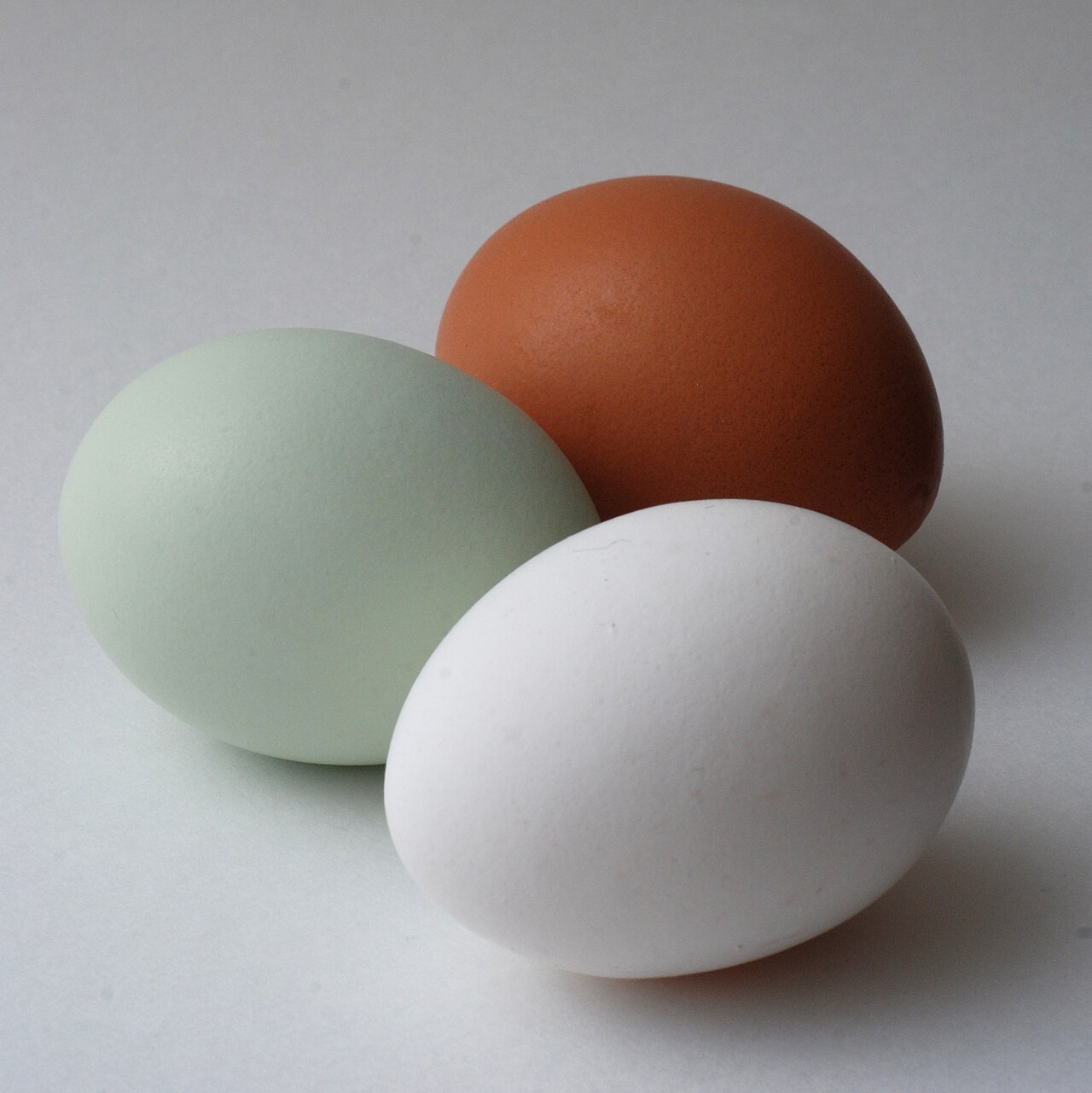
Chickens that lay colored eggs include Araucanas, Ameraucanas and Cream Legbars (blue), Easter Eggers (blue or green), Olive Eggers (olive), and Marans and Welsummers (dark chocolate brown). Blue eggs come from a dominant gene called oocyan that puts blue pigment through the entire shell, while green and olive eggs are blue shells with a brown coating on top.
Here is a table of colored egg layers by shade, how egg color actually works, and what to expect from each breed. Egg counts are typical hatchery ranges, and shade varies from hen to hen.
Colored Egg Layers by Color
Use this table to plan a mixed carton.
| Shell Color | Breeds | How the Color Forms | Eggs per Year (Typical) |
|---|---|---|---|
| Blue | Araucana, Ameraucana, Cream Legbar | Blue pigment (biliverdin) through the whole shell | 180 to 260 (Araucana); 180 to 200 (Ameraucana, Cream Legbar) |
| Blue or green | Easter Egger | Blue shell, sometimes with a light brown overlay | 200 to 250 |
| Olive | Olive Egger | Blue shell with a dark brown overlay | 180 to 200 |
| Dark brown to chocolate | Marans, Welsummer | Heavy brown pigment (protoporphyrin) on the surface | 200 or more (Marans); 200 to 280 (Welsummer) |
| Cream or tinted | Silkie, Faverolles | Light brown wash on a white shell | 90 to 120 (Silkie); 180 to 240 (Faverolles) |
How Eggshell Color Works
The calcium shell itself is white. Color is added as the shell forms in the hen’s shell gland, and two main pigments do almost all the work: biliverdin, which makes blue, and protoporphyrin, which makes brown.
The Blue Egg Gene (Oocyan)
Blue eggs come from a single dominant gene, traditionally written as oocyan (O) and first described by geneticist Reginald Punnett in 1933. In 2013, researchers publishing in PLOS Genetics pinned down the cause: a piece of ancient retrovirus DNA, called EAV-HP, inserted next to a gene named SLCO1B3. That insertion switches the gene on in the shell gland, and the hen deposits biliverdin, a blue-green pigment, into the shell as it forms.
Because the pigment goes into the shell itself, blue eggs are blue inside and out. Because the gene is dominant, a hen needs only one copy to lay blue eggs, although hens with two copies tend to lay a darker blue than hens with one. That is why crossing a blue-egg rooster with brown-egg hens can produce daughters that lay green or olive eggs.
Brown Is a Coating
Brown pigment works differently. Protoporphyrin is laid down on the outside of the shell, so a brown egg is white or pale on the inside when you crack it. The more pigment a hen deposits, the darker the egg, which is why Marans and Welsummer eggs can look like chocolate.
Green and Olive: Blue Plus Brown
Green and olive eggs are blue shells with a brown overlay. A hen that carries the blue gene and also deposits some brown pigment lays a green egg, and a heavier brown coat produces olive. Cackle Hatchery makes its Olive Eggers by crossing a blue-egg breed with a dark brown-egg breed, and the depth of olive depends on how dark the brown layer is.
You can check this at home: the inside of a green or olive eggshell is blue.
Blue Egg Layers
True blue eggs come from breeds that carry the oocyan gene with little or no brown pigment.
Araucana
The Araucana traces to Chilean chickens and lays pale blue eggs, roughly 180 to 260 a year by hatchery estimate. Standard Araucanas are rumpless, with no tail, and have ear tufts, small feather tufts that grow from the sides of the neck near the ears.
The tuft gene is lethal when a chick inherits two copies, so some chicks die in the shell, and rumplessness can reduce fertility. Araucanas are rewarding but best suited to keepers ready for a breeding challenge.
Ameraucana
The Ameraucana was developed in the United States in the 1970s from Araucana stock, keeping the blue egg but adding a tail and dropping the ear tufts. It has a beard, muffs and a pea comb, and Mississippi State University Extension notes eight recognized color varieties. Expect about 180 to 200 medium to large blue eggs a year.
Many chicks sold as Ameraucanas at farm stores are actually Easter Eggers. If you want the true breed, buy from a breeder or a hatchery that sells them by named color variety.
Cream Legbar
The Cream Legbar was developed at Cambridge University by Reginald Punnett and Michael Pease, and it lays blue to greenish-blue eggs, about 180 to 200 a year. It is crested and auto-sexing, so chicks can be sexed at hatch by down color.
Legbars are active foragers that handle both heat and cold. Their eggs are often a minty or aqua blue rather than sky blue.
Green and Olive Egg Layers
These birds combine the blue gene with some brown pigment, so their shells are blue underneath a brown coat.
Easter Egger
Easter Eggers are not a recognized breed but a colorful backyard type with blue-egg ancestry. Cackle Hatchery notes hens lay pale to dark blue, several shades of green, and sometimes light brownish or pinkish eggs, with each hen usually sticking to one color. Expect about 200 to 250 eggs a year.
They are friendly, hardy and widely available, which makes them the easiest way for a beginner to get colored eggs. Easter Egger bantams lay the same colors in a smaller size.
Olive Egger
Olive Eggers are crosses between a blue egg layer and a dark brown egg layer. Cackle Hatchery pairs Cream Legbar roosters with Welsummer hens, estimates 180 to 200 eggs a year, and reports that about 97 percent of its Olive Egger hens lay olive-colored eggs.
Shades run from light sage to deep green-brown. Like Easter Eggers, Olive Eggers are hybrids, so size and temperament vary from bird to bird.
Chocolate and Dark Brown Egg Layers
These breeds do not carry the blue gene. They simply deposit a lot of brown pigment.
Marans
Black Copper Marans are the best-known dark egg breed, laying deep reddish-brown eggs, often with dark speckles. Stromberg’s estimates 200 or more large eggs a year and describes the French type as calm and docile, with feathered feet.
Egg darkness varies by line, and many hens lay lighter eggs as the season goes on. Buy from a source that selects for dark eggs if color matters to you.
Welsummer
Welsummers, a Dutch breed, lay dark terracotta-brown eggs that are often speckled, and hatcheries list 200 to 280 a year. They are active, friendly birds and keen foragers.
Welsummer hens are a popular parent for olive eggers because of their rich brown pigment.
Does Egg Color Affect Taste or Nutrition?
No. Shell color does not affect nutrition or taste, according to Mississippi State University Extension. What the hen eats has far more influence on the yolk and flavor than the color of the shell.
Brown eggs often cost more in stores because the hens that lay them tend to be larger and eat more, not because the eggs are better.
Tips for a Colorful Flock
A little planning gets you the carton you want:
- Mix three or four types, such as an Ameraucana, an Easter Egger, an Olive Egger and a Marans.
- Expect each hen to lay one shade, though it may lighten as the season goes on.
- Buy named breeds from reputable hatcheries or breeders if a specific shade matters.
- Choose Easter Egger or Ameraucana bantams if space is tight; their eggs are smaller but just as colorful.
With a few of these breeds in the coop, every egg run becomes a small surprise, and the colors are a fun way to tell at a glance which hens are laying.
Frequently Asked Questions
Quick answers to common questions about chickens that lay colored eggs.
Can a Chicken Lay Different Colored Eggs?
No, a hen lays the same basic egg color throughout her life because shell color is set by her genes, though the shade can lighten as the laying season goes on. To get several colors in one carton, keep several breeds, such as an Ameraucana, an Olive Egger and a Marans.
What Chickens Lay Pink Eggs?
Easter Eggers are the best-known chickens that sometimes lay pinkish eggs, alongside the blue, green and light brown shades the type produces. Each Easter Egger hen usually sticks to one color, so the only way to know whether a hen lays pink is to see her eggs.
What Chickens Lay Speckled Eggs?
Black Copper Marans and Welsummers are the chickens best known for speckled eggs, laying deep reddish-brown or terracotta shells often marked with darker spots. The speckles are extra brown pigment on the surface, and darkness varies from hen to hen and through the season.
Do Bantam Chickens Lay Colored Eggs?
Yes, bantam chickens lay the same egg color as the large version of their breed, so Easter Egger and Ameraucana bantams lay blue or green eggs. The eggs are smaller, about two-thirds the size of a standard egg, but just as colorful.
Sources (5)
Facts on this page were checked against these references.
- PLOS Genetics (Wang et al., 2013): An EAV-HP Insertion in 5′ Flanking Region of SLCO1B3 Causes Blue Eggshell in the Chicken
- Cackle Hatchery: Olive Egger Chickens, 6 Questions Answered
- Cackle Hatchery: Easter Egger Chicken
- Stromberg’s Chicks and Game Birds: French Black Copper Maran Chicks
- Mississippi State University Extension: Choosing the Right Breed for Your Backyard Flock (P3036)
 Best Egg Laying Chickens