
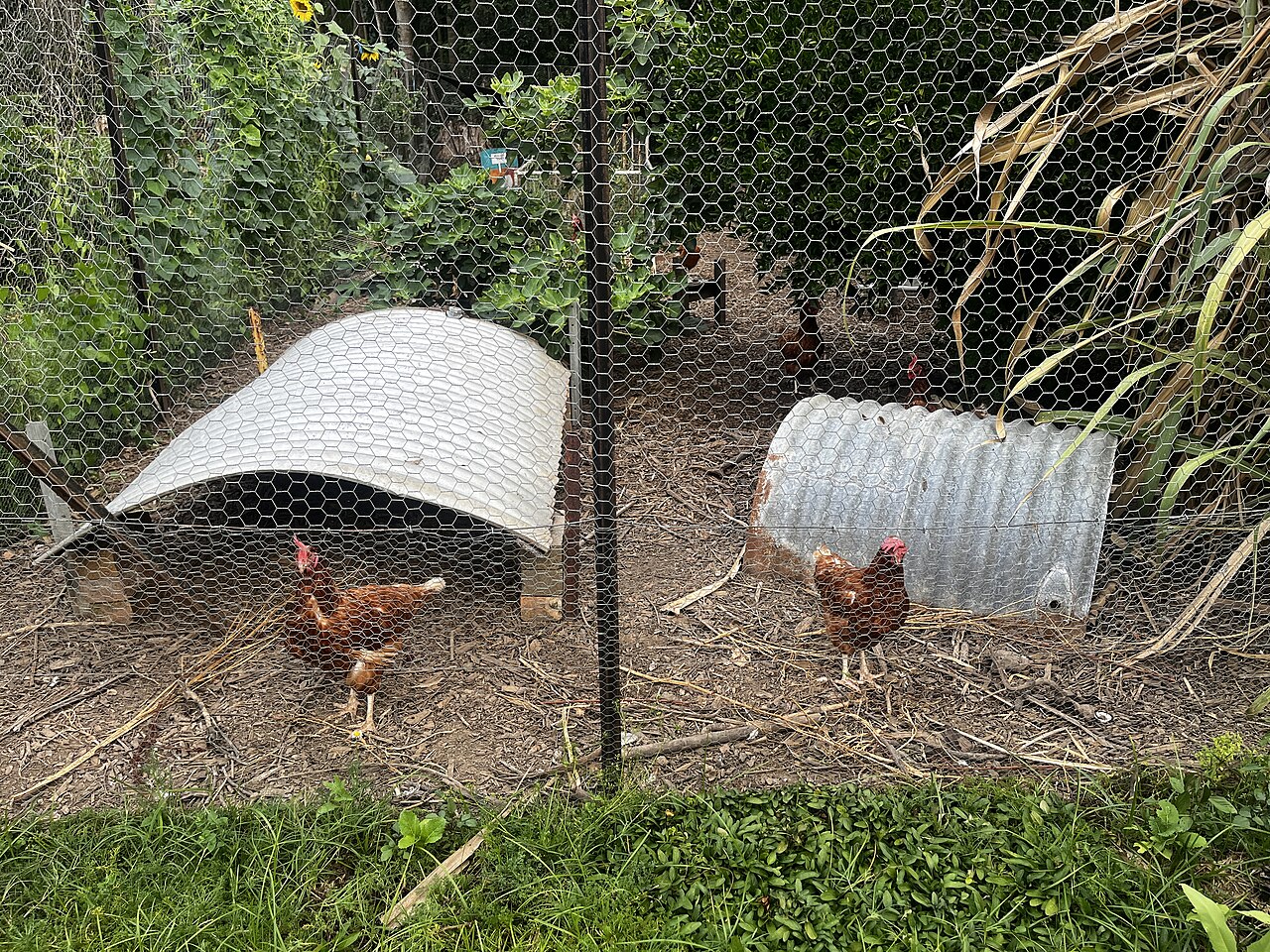
A backyard chicken coop needs about 4 square feet of floor space per standard-size hen and about 2 square feet per bantam, plus roughly 10 square feet of outdoor run per standard bird and 5 per bantam. If your flock spends most of its time shut in, plan on about one and a half times those figures.
Enter your flock below and the calculator works out coop floor area, run area, roost length and the number of nesting boxes in one step. It handles mixed flocks of standard birds and bantams, which is useful because small breeds need noticeably less room than the big ones.
How the Calculator Works
The calculator asks three things: how many standard-size chickens you keep, how many bantams you keep, and whether the flock free ranges during the day or is mostly confined to the coop and run. It then adds up the space each bird needs and gives you four results.
Coop floor space is 4 square feet per standard bird and 2 square feet per bantam. Run space is 10 square feet per standard bird and 5 square feet per bantam. If you choose mostly confined, both the coop and run totals are multiplied by 1.5. Roost length is 10 inches per standard bird and 6 inches per bantam, and the nesting box count is one box for every four birds, rounded up to the next whole box.
| Result | Standard Bird | Bantam | Mostly Confined |
|---|---|---|---|
| Coop floor | 4 sq ft | 2 sq ft | Total x 1.5 |
| Run | 10 sq ft | 5 sq ft | Total x 1.5 |
| Roost length | 10 inches | 6 inches | No change |
| Nesting boxes | 1 per 4 birds | 1 per 4 birds | No change |
These are planning figures for a comfortable backyard flock. They are not the bare minimum a bird can survive in, and that difference is deliberate.
Where the Space Rules Come From
Extension services publish a wide range of figures, because commercial housing, small farm housing and backyard housing are different situations. The national extension poultry resource recommends 3 to 4 square feet of indoor space per laying hen and 10 square feet of outdoor run per hen. University of Minnesota Extension suggests at least 3 to 5 square feet of indoor space per bird for a small laying flock.
Some older extension tables list lower numbers. University of Maryland Extension, for example, lists 1.5 to 2 square feet of floor space for laying hens and large chickens and 1 square foot for bantams, with outdoor runs of 8 to 10 square feet for standard birds and 4 for bantams. Utah State University Extension gives 1.5 to 2 square feet of floor space per adult bird. Those figures describe tighter housing where management is intensive.
The calculator uses the top of the backyard range, 4 square feet for a standard bird, because most home keepers want birds that stay calm, keep their feathers and do not pick at each other. Crowding is one of the most common causes of bullying and feather pecking in small flocks, and extra space is the cheapest fix there is.
Why Bantams Get Half the Space
Bantams are miniature chickens, often described as about one quarter the size of large fowl. They eat less and need less room, which is a big part of their appeal for small yards. Maryland Extension’s table gives bantams roughly half the floor and run space of large birds, and the calculator follows that same proportion: 2 square feet of coop and 5 square feet of run per bantam.
Half is still generous for the smallest true bantams such as Sebrights, and about right for larger bantam versions of breeds like Cochins, Wyandottes and Orpingtons. If your bantams are the bigger types, round up rather than down.
Why Confinement Raises the Numbers
Extension guidance notes that outdoor allowances only apply when birds actually use the outdoors, and that indoor space needs go up when weather keeps birds inside for long stretches. A flock that free ranges all day uses the coop mostly for sleeping and laying. A flock that never leaves its coop and run lives in that space around the clock, so the calculator adds 50 percent to both figures when you choose mostly confined.
Roost Length and Nesting Boxes
Chickens sleep shoulder to shoulder on a perch, but they still need elbow room to get on and off without a scuffle. Utah State University Extension recommends 6 to 10 inches of perch per chicken, and Maryland Extension suggests 6 to 7 inches. The calculator uses 10 inches for standard birds, which suits heavy breeds and winter nights when birds fluff up, and 6 inches for bantams.
Several shorter perches add up just as well as one long one. If the calculator says 60 inches, two 30-inch bars at the same height work fine. Keep all perches at roughly the same height, or the birds will fight over the top rung.
For nesting boxes, extension services commonly recommend one box for every four to five hens. The calculator uses one per four birds and rounds up, so five hens get two boxes. Hens tend to share a favorite box anyway, but a spare reduces squabbling, broken eggs and hens laying on the floor. A box about 12 inches square suits most standard hens, and bantams are comfortable in smaller boxes.
Worked Examples
The table below shows what the calculator returns for a few common flocks. Use it to sanity-check your own plans or to compare coop kits before you buy.
| Flock | Free Range or Confined | Coop Floor | Run | Roost | Nest Boxes |
|---|---|---|---|---|---|
| 4 standard hens | Free range | 16 sq ft | 40 sq ft | 40 in | 1 |
| 6 bantams | Free range | 12 sq ft | 30 sq ft | 36 in | 2 |
| 3 standard and 4 bantams | Mostly confined | 30 sq ft | 75 sq ft | 54 in | 2 |
| 12 bantams | Free range | 24 sq ft | 60 sq ft | 72 in | 3 |
| 10 standard hens | Mostly confined | 60 sq ft | 150 sq ft | 100 in | 3 |
Notice how a dozen bantams need less coop space than six confined standard hens. That is the bantam advantage in numbers, and it is why small breeds are a popular choice for suburban lots and tight city yards.
Reading Coop Kit Capacity Claims
Many prefabricated coops are sold as suitable for a certain number of chickens. Those counts are often based on very tight spacing, sometimes closer to commercial minimums than to what a backyard flock needs to stay peaceful. Measure the interior floor yourself, leaving out nest boxes that hang outside the wall, and divide by the calculator’s per-bird figure.
A small kit advertised for six birds may only have 12 to 18 square feet of floor. By the figures above, that suits three or four standard hens, or six to nine bantams if they also get a good run. Kits often make more sense for bantam flocks than for large fowl.
When to Go Bigger
The calculator gives a sensible starting point, but several situations call for more room than the formula suggests.
- You live where snow or cold rain keeps birds inside for weeks at a time.
- You keep large breeds such as Brahmas, Jersey Giants or Orpingtons.
- You plan to add birds later, which most keepers eventually do.
- You keep a rooster or birds with a history of pecking.
- You want room for feeders and waterers inside the coop rather than in the run.
Feeders, waterers and dust baths all take up floor area that birds cannot use for moving around. If those sit inside the coop, add a few square feet for each. Building one size up is almost always cheaper than replacing a coop that turned out to be too small after the second batch of chicks.
Other Things a Good Coop Needs
Space is only one part of a healthy coop. Ventilation matters just as much, since a closed-up coop builds moisture and ammonia that can harm birds’ lungs and cause frostbite in winter. Maryland Extension recommends adjustable vents so air keeps moving in both hot and cold weather. Vents high on the walls, above roost height, let damp air escape without blowing a draft across sleeping birds.
Predator protection is the other essential. Use hardware cloth rather than chicken wire on openings and the run, bury or apron the run edges to stop diggers, and shut birds in at night. A larger coop is only better if it is also secure, dry and easy for you to clean.
Frequently Asked Questions
Quick answers to common questions about coop and run space.
What Size Chicken Coop Do You Need for 6 Chickens?
Six standard chickens need about 24 square feet of coop floor and 60 square feet of run, plus 60 inches of roost and 2 nesting boxes. If the flock is mostly confined, plan on about 36 square feet of coop and 90 square feet of run.
How Big Should a Chicken Coop Be for 10 Chickens?
A coop for 10 standard chickens should have about 40 square feet of floor space and 100 square feet of run if the birds free range, or 60 and 150 square feet if they are mostly confined. Add 100 inches of roost and 3 nesting boxes.
How Many Chickens Fit in a 4×8 Coop?
A 4×8 coop has 32 square feet of floor, enough for about 8 standard chickens or 16 bantams that free range during the day. If the birds are mostly confined, plan on about 5 standard hens or 10 bantams instead.
How Much Space Does a Bantam Chicken Need?
A bantam chicken needs about 2 square feet of coop floor and 5 square feet of run for comfortable backyard keeping, roughly half the space of a standard hen. Some extension tables list a 1 square foot indoor minimum for bantams, but extra room reduces bullying and feather pecking.
Sources (5)
These are the references used to check the facts on this page.
- Extension Poultry: Space Allowances in Housing for Small and Backyard Poultry Flocks
- University of Minnesota Extension: Raising Chickens for Eggs
- University of Maryland Extension: Chicken Housing
- Utah State University Extension: Basics for Raising Backyard Chickens
- University of Maryland Extension: Chickens
 Chicken Feed Calculator
 Egg Production Calculator
 Chicken Breed Finder