
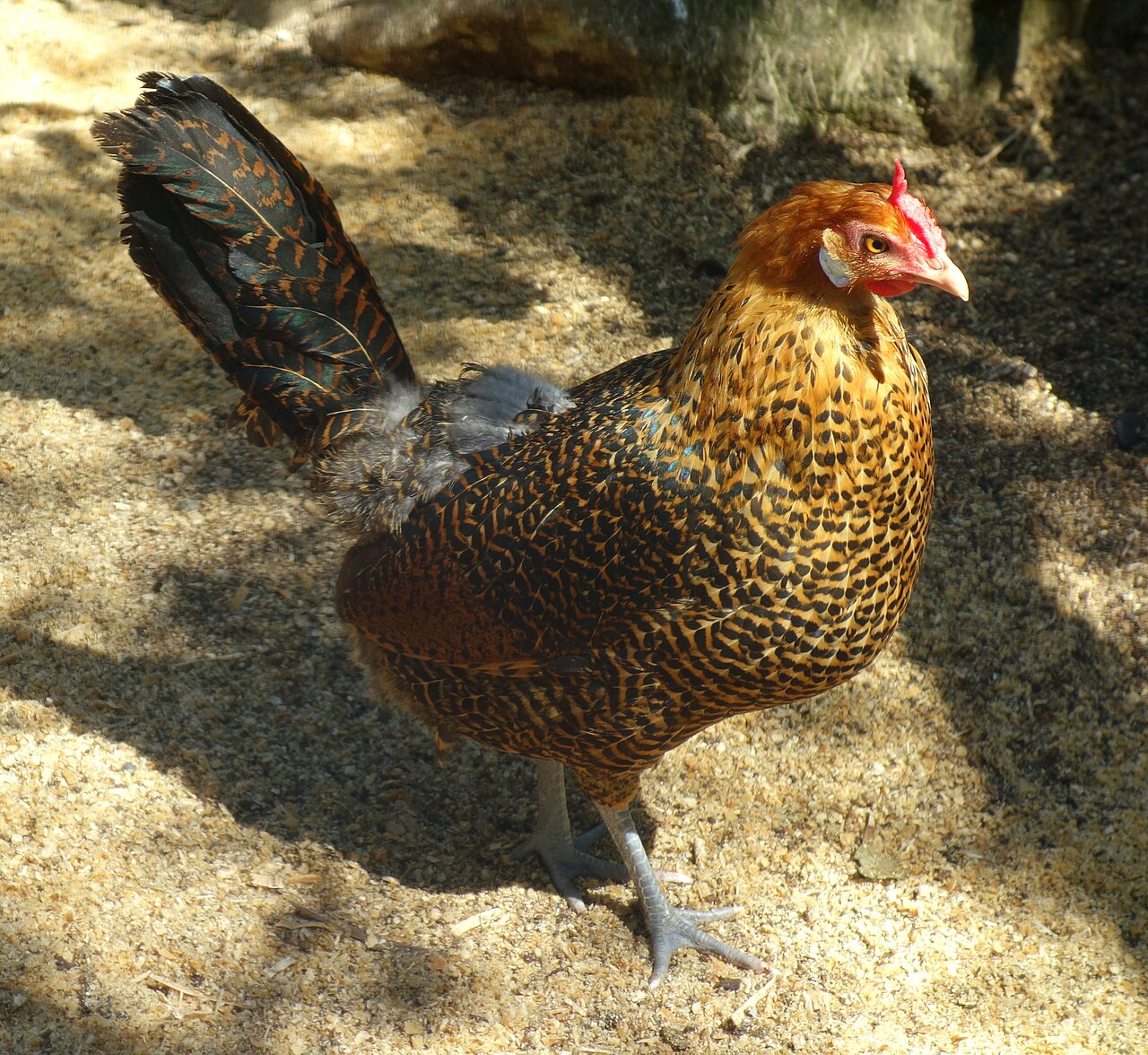
The Sebright chicken is a tiny English true bantam famous for its laced plumage, with every feather crisply edged in black, and for roosters that look almost exactly like hens. Developed by Sir John Sebright in the early 1800s, it is one of the oldest British bantams, and APA standard weights are only 22 ounces for a cock and 20 ounces for a hen.
Sebrights are ornamental birds first. They are lively, beautiful and inexpensive to feed, but hens lay only around 60 to 80 small eggs a year, they fly well, and they are not the hardiest breed in cold, damp weather. Here is what to expect before you add them to your yard.
Sebright Quick Facts
- Egg color
- White, Cream
- Eggs per year
- 60 to 80
- Egg size
- Small
- Size class
- True bantam
- Hen weight, bantam
- 20 oz
- Rooster weight, bantam
- 22 oz
- Temperament
- Active
- Cold hardiness
- Low
- Heat hardiness
- High
- Broodiness
- Rare
- Noise level
- Moderate
- Good for beginners
- No
- Confinement
- Fair
- Purpose
- Ornamental
- Start of lay
- 20 to 26 weeks
- Comb type
- Rose
- Feathered feet
- No
- Crest
- No
- Origin
- England
- APA / ABA recognition
- APA: Rose Comb Clean Legged Bantam (1874); ABA: Rose Comb Clean Legged
- Conservation status
- Watch
- Lifespan
- 7 to 10 years
History and Origin
The breed is named for Sir John Saunders Sebright, 7th Baronet of Besford in Worcestershire, an English Member of Parliament with a serious interest in animal breeding. He set out to create a small bantam with perfectly defined lacing, an ambitious goal at a time when breed creation was more art than science.
Sebright collected unusual birds from local flocks and possibly from abroad. His exact method was never recorded, but the breed is thought to include Nankin, Rosecomb, Polish and Hamburg blood. According to Oklahoma State University, the gold variety likely traces to a buff Nankin hen and the silver to a white Rosecomb cockerel. After roughly 20 to 30 years of work, he introduced the breed around 1810, which makes the Sebright one of the oldest British bantam breeds.
The Sebright was admitted to both the Poultry Club of Great Britain standard and the American Poultry Association’s Standard of Perfection in 1874. Today the Livestock Conservancy lists it with Watch status, meaning numbers are limited and the breed benefits from dedicated keepers.
Appearance and Varieties
A good Sebright is compact and proud, with a short back, a full, rounded breast and wings that are large for its size and carried angled down toward the ground. The tail is full and held high, at about 70 degrees. The overall look is often compared to a pigeon or a little fan-tailed bird.
Lacing and Hen Feathering
The defining feature is lacing. Each short, rounded feather has a sharp black border around a gold or silver center, and the pattern repeats across the whole body, wings and tail. Even, clean lacing is hard to achieve, which is why exhibition Sebrights are prized.
Sebright males are hen feathered. They lack the long, pointed hackle, saddle and sickle feathers that most roosters grow, so their plumage is rounded and laced just like a hen’s. The easiest way to tell the sexes apart is the comb and wattles, which are larger on males, and the male’s behavior, since roosters still crow and display.
Comb, Legs and Recognized Varieties
Sebrights have a rose comb, ideally mulberry (dark purplish red) or a deep red, ending in a spike called a leader that points straight back. Legs and skin are slate blue, and eyes are large, round and dark. The APA recognizes two varieties, Golden and Silver, in the Rose Comb Clean Legged bantam class. Breeders keep other colors, but these are not accepted for APA showing.
| Variety | Ground Color | Lacing | Beak |
|---|---|---|---|
| Golden Sebright | Rich golden bay | Black | Dark horn |
| Silver Sebright | Silvery white | Black | Dark blue or horn |
Temperament
Sebrights are active, curious and spunky. They are easily tamed when handled young, but they are not cuddly lap birds and generally prefer to be busy. Cackle Hatchery describes them as spirited and alert, often livelier than calmer bantams such as Silkies or Cochins.
They are strong fliers for a chicken. Sebrights will fly up into trees to roost if given the chance and can be hard to catch, so a covered run is the practical choice. They can also be vocal when startled or agitated. Roosters vary: many are manageable, while some are noisy and assertive, as small roosters often are.
Egg Laying
Sebrights are poor layers. A typical hen lays about 60 to 80 small eggs a year, with cream to white shells. The Livestock Conservancy notes that fertility varies by strain, and Cackle Hatchery lists hatch fertility at around 40 to 55 percent, which is low compared with many breeds.
Hens rarely go broody and have weak maternal instincts. If you want to hatch Sebright eggs, plan on an incubator or a broody hen of another breed, such as a Silkie or Cochin, as a foster mother.
Keep your expectations realistic. A small flock of Sebrights will give you occasional eggs for the kitchen, but if you want a steady supply, add a few productive layers to the flock.
Care Needs
Sebrights eat very little and need less coop and run space than large fowl, which makes them easy to fit into a small yard. Their care needs center on three things: containment, climate and disease prevention.
Containment and Housing
Because they fly so well, a fully covered run is the best way to keep Sebrights safe from hawks and from wandering. Small birds are also easy prey for cats, raccoons and rats, so use hardware cloth rather than chicken wire. Cackle suggests roosts at about 2 to 4 feet high.
Climate and Health
The Livestock Conservancy notes that Sebrights do poorly in cold, damp conditions and do best in warm climates. In northern winters, give them a dry, well-ventilated, draft-free coop and watch for frostbite on the rose comb. The breed is also considered susceptible to Marek’s disease, so buy chicks vaccinated against it whenever possible. For any sick bird, contact a veterinarian who treats poultry.
Is There a Large Sebright?
No. The Sebright is a true bantam, meaning it was created as a small bird and has no large fowl counterpart. There is no standard-size Sebright in the APA or Poultry Club of Great Britain standards, and the breed’s small size is part of its definition. If you want laced plumage in a larger bird, look at large fowl breeds with laced varieties, such as the Wyandotte.
Who the Sebright Suits
The Sebright suits keepers who want striking ornamental birds for a small yard, exhibitors looking for a classic show bantam, and anyone who enjoys an active, characterful flock. It is a popular 4-H show breed because the birds are small, easy to carry and visually striking on the show table.
Oklahoma State University considers the Sebright a poor choice for beginners, largely because of its susceptibility to Marek’s disease, and the Livestock Conservancy notes that its low egg production makes it challenging for new keepers. If eggs or easy hatching matter to you, a Silkie, Cochin bantam or Orpington is a more forgiving choice.
Where to Buy Sebright Chicks
Sebright chicks are sold by several major hatcheries, including Cackle Hatchery, usually as Golden and Silver chicks shipped from late winter through summer. Hatchery Sebrights are attractive backyard birds, though their lacing is often less precise than show stock.
For exhibition quality, look for breeders through the American Bantam Association, the Livestock Conservancy’s breeders directory and local poultry shows. Choose flocks enrolled in the National Poultry Improvement Plan (NPIP), and ask about Marek’s vaccination before you buy.
Frequently Asked Questions
Quick answers to common questions about Sebright chickens.
How Long Do Sebright Chickens Live?
A Sebright chicken typically lives 7 to 10 years. Keeping Sebrights warm and dry in winter, in a covered run safe from hawks, and buying chicks vaccinated against Marek’s disease gives these small bantams the best chance at a long life.
When Do Sebright Hens Start Laying?
Sebright hens usually start laying at about 20 to 26 weeks of age. Expect only around 60 to 80 small eggs a year after that, since the Sebright is an ornamental breed rather than a production layer.
Can You Eat Sebright Chicken Eggs?
Yes, Sebright eggs are edible and taste like any other chicken egg. They are small, with white to cream shells, and a Sebright hen lays only about 60 to 80 a year, so they are an occasional treat rather than a steady kitchen supply.
Are Sebright Chickens Noisy?
Sebright chickens are moderately noisy. Hens are vocal when startled or agitated, and Sebright roosters crow and display like any rooster, so a Sebright flock with a male is not a quiet choice for close neighbors.
Sources (4)
Breed facts and figures on this page were checked against these references.
 Polish Chicken
 Sussex Chicken
 Lavender Orpington
 Easter Egger Chicken