
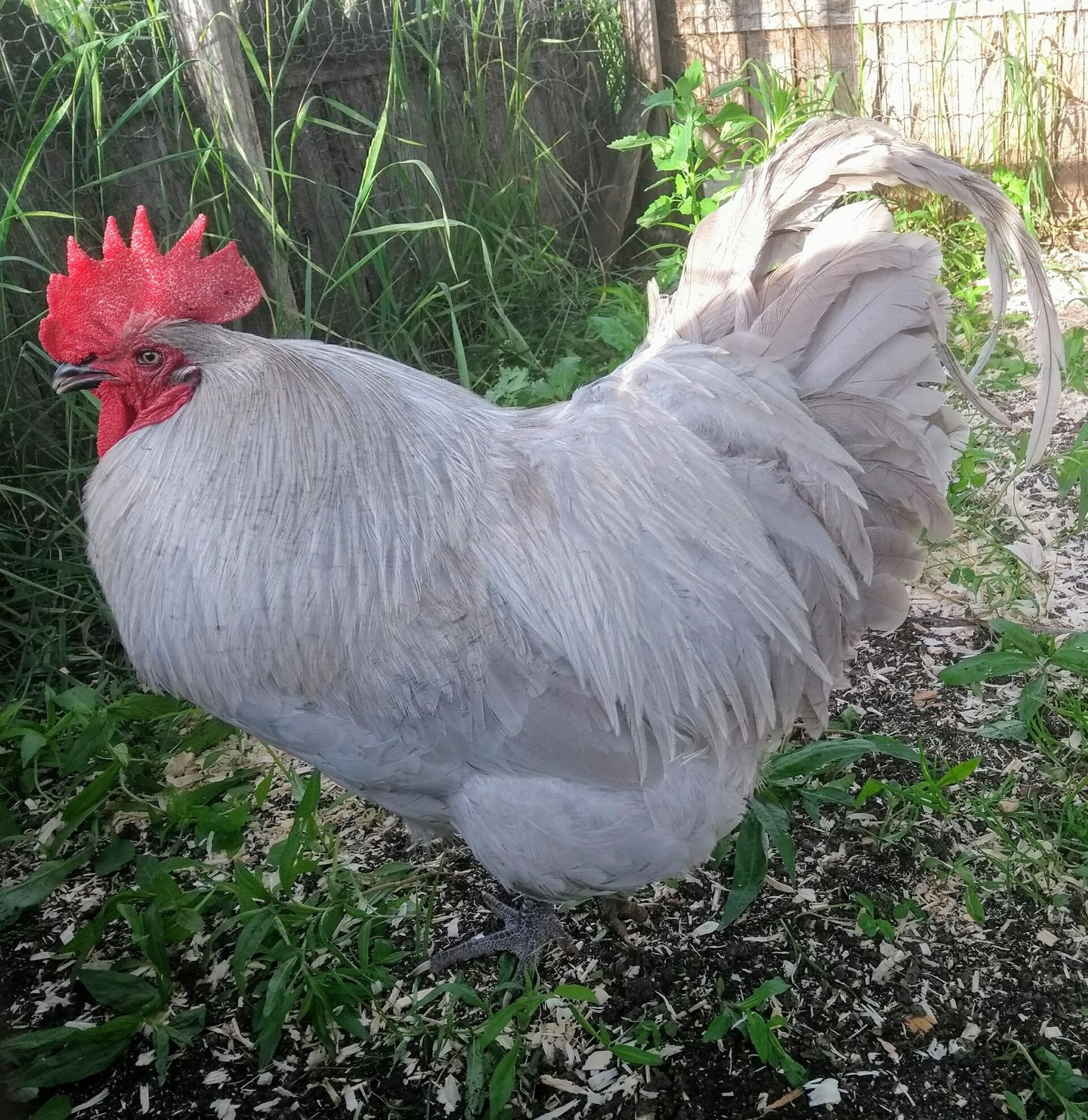
A Lavender Orpington is an Orpington chicken with two copies of the recessive lavender gene, which dilutes black feather pigment to an even, pale slate gray (often called self blue). It is not an officially recognized variety in the United States, since the American Poultry Association (APA) and the American Bantam Association (ABA) both list only Black, Blue, Buff and White Orpingtons.
The lavender Orpington chicken has the same heavy, docile build as other Orpingtons, so this page sticks to what the color changes, including genetics, feather quality, breeding results, type and price. For the breed’s general history and care, see our Buff Orpington profile.
Lavender Orpington Quick Facts
- Egg color
- Brown
- Eggs per year
- 150 to 220
- Egg size
- Medium
- Size class
- Large fowl and bantam
- Hen weight, standard
- 8 lb
- Rooster weight, standard
- 10 lb
- Hen weight, bantam
- 34 oz
- Rooster weight, bantam
- 38 oz
- Temperament
- Docile
- Cold hardiness
- High
- Heat hardiness
- Medium
- Broodiness
- Frequent
- Noise level
- Quiet
- Good for beginners
- Yes
- Confinement
- Good
- Purpose
- Dual purpose
- Start of lay
- 20 to 26 weeks
- Comb type
- Single
- Feathered feet
- No
- Crest
- No
- Origin
- England; lavender color reportedly developed in the UK in the 1990s
- APA / ABA recognition
- Not recognized
- Conservation status
- Not listed (Orpington graduated from the priority list in 2016)
- Lifespan
- 8 to 10 years
History and Origin
William Cook introduced the Orpington in 1886, in Kent, England. The lavender color came roughly a century later, and, by the accounts below, it came from outside the breed.
Origin of the Lavender Gene
The lavender mutation was first documented in 1972, and it was discovered in the Porcelain variety of Belgian Bearded d’Uccle bantams. In 2008, researchers traced the color to a single point mutation in the melanophilin (MLPH) gene, the first MLPH mutation reported in a bird.
The mutation leaves pigment patchily transferred into the growing feather, so the barbs end up with a mix of pigmented and unpigmented regions. It is inherited as an autosomal recessive trait, and it dilutes black to slaty blue or light gray, and red to beige or buff.
Who Developed the Lavender Orpington
Priscilla Middleton is credited with developing Lavender Orpingtons in the UK, starting in the mid-1990s.
The story usually told, drawn from her 2008 Practical Poultry article “Ladies in Lavender,” is that she crossed a black Orpington hen with a lavender, Leghorn-type rooster from a group a friend spotted at a sale in Ross-on-Wye. The original article could not be checked directly, so treat this as a hobby account rather than documented history.
Lavender vs Blue Orpington
Lavender and blue can look alike in photos, but they are different genes. The practical difference is that lavender breeds true, while blue does not.
Why Blue Does Not Breed True
The blue gene shows with a single copy. A black bird with one copy looks blue, and two copies give splash, so two blue parents produce about 50 percent blue, 25 percent black and 25 percent splash chicks.
Lavender needs two copies to show, so a visibly lavender bird has nothing else to pass on. Pairing two lavenders gives 100 percent lavender chicks, so the color breeds true.
How to Tell Them Apart
Lavender is a pale silvery blue, with all feathers one uniform shade. It is not a lighter shade of blue, and it lacks the darker shade seen in normal blue. The silver tint shows most in the cock’s neck and saddle hackles.
Breeding Lavender Orpingtons
A split is a bird that looks black but carries one lavender gene. Breeders rely on splits, which is why black Orpingtons turn up in lavender programs and why split-to-lavender chicks and hatching eggs are sold alongside lavender ones.
Expected Results from Common Pairings
These ratios are averages rather than guarantees for any one hatch. No visual test separates a true black from a split, so DNA testing is the direct check. The pairings below also offer a slower check, since a lavender chick from a black bird mated to a lavender one shows that the black parent is a split.
| Pairing | Expected Chicks |
|---|---|
| Lavender x lavender | 100 percent lavender |
| True black x lavender | 100 percent split (all look black) |
| Split x lavender | 50 percent lavender, 50 percent split |
| Split x split | 25 percent lavender, 50 percent split, 25 percent true black |
| True black x split | 50 percent true black, 50 percent split (all look black) |
Feather Quality and Split Feathers
Split feathers are a separate issue from split birds. One hatchery’s explanation is a recessive shredder gene linked to lavender, which causes feathers to split and barbs to detach, giving rough-looking plumage. Lavender Orpingtons are named as affected, and a poultry author describes the same ragged look in lavender Ameraucanas.
The practical fix is breeding lavender to black to make splits, then breeding splits back to lavender and keeping the best feathered offspring. The same reasoning explains why black birds get added to lavender lines.
This explanation rests on hatchery and breeder accounts. The abstract of the 2008 study that identified the lavender mutation describes color dilution and mentions no feather defect, so treat the shredder gene as a working breeder’s explanation, and ask to see the parents’ feathering before you buy.
Is the Lavender Orpington Officially Recognized?
No, not by either American association. The APA’s accepted breeds list shows Black, Blue, Buff and White Orpingtons in large fowl (English class) and in bantam (Single Comb Clean Legged). The ABA’s March 2021 list shows the same four bantam varieties in Single Comb Clean Legged.
Newer documents point the same way. The ABA supplement dated January 2026 does not mention Orpingtons, and the five APA qualifying meets announced for the 2026 Ohio National did not include one. Self blue itself is accepted in other breeds, including ABA-listed Silkies and the APA’s Standard Self Blue Ameraucana.
What Recognition Would Take
APA guidelines ask for affidavits from at least five breeders who have each bred the variety for at least five years. They also require two qualifying meets at least a year apart, each with at least 25 birds from five exhibitors, before the Standards Committee can recommend acceptance.
Showing a Lavender Orpington
Unrecognized does not always mean barred from the show hall. APA rules say non-recognized varieties may only be awarded RV and BV and cannot compete for association special prizes and awards, and ABA rules set the same ceiling. Check with the show secretary before entering.
Outside the United States
The picture varies abroad. The United Orpington Club’s list of UK colors omits lavender, and The Happy Chicken Coop says it is not official in the UK, although The Orpington Club names it among standard-sized Orpington colors. Poultry Club South Africa, by contrast, publishes a Lavender Orpington color description, also calling it Reynolds Blue.
Appearance and Varieties
Apart from color, a Lavender Orpington should look like any Orpington, with a heavy body, loose feathering and a single comb. Poultry Club South Africa calls for a bright red comb, lead gray shanks and orange red to dark brown eyes in lavender birds, and it faults lacing or a yellowish tinge.
| Size | Cock | Hen | Egg Size |
|---|---|---|---|
| Standard | 10 lb | 8 lb | Medium |
| Bantam | 38 oz | 34 oz | Small |
These are Orpington breed weights, published by the United Orpington Club for recognized varieties, because no American standard exists for lavender. Cockerels and pullets run 8.5 lb and 7 lb in standard size, and 34 oz and 30 oz in bantam. Actual birds vary, and Murray McMurray lists its lavender males at 9.5 lb and females at 6.5 lb.
Chick Color
Lavender chicks do not always look lavender. Descriptions range from a soft pale gray mixed with very pale yellow to light lavender or gray-blue, sometimes with yellow underbellies, and one breeder reportedly had chicks hatch almost white. Split chicks hatch black.
Hatchery vs English Type
Type and color are separate questions, and lavender comes in both. Cackle Hatchery lists its regular Lavender Orpington at about 8 lb for hens and 10 lb for roosters, with about 150 eggs a year. Its Lavender English Orpington is listed at about 12 lb and 15 lb, with about 90 to 120 eggs, at a much higher price.
Keepers describe English birds as stockier and heavier boned, and so fluffy that their legs barely show, while hatchery birds are leggier and probably lay better. Cackle’s English weights sit well above the 8 lb and 10 lb standard weights, so treat them as a hatchery’s description rather than a standard.
Temperament
Lavender Orpingtons are described in the same terms as other Orpingtons, as docile, friendly and very gentle birds. One customer review on a hatchery site did find its lavender hens less sociable than other Orpingtons.
Orpington chicks are not very aggressive, and they are often the underdogs when several breeds are brooded together. Orpingtons are also described as quiet birds.
Broodiness is common, though ratings differ. Cackle lists its regular lavender as broody, Valley Hatchery rates its birds as setters that regularly go broody, McMurray’s Q&A calls all Orpingtons excellent setters, and Tractor Supply says Orpington hens are typically very broody. Hoover’s says occasionally, McMurray’s chart says somewhat likely, and Cackle rates its Lavender English Orpington as occasional.
Egg Laying
Published egg counts for hatchery-type lavender vary widely, from about 150 to 220 a year. Cackle and Valley Hatchery list about 150, Dunlap Hatchery 170 to 200, and Hoover’s Hatchery 220, while Cackle’s Lavender English Orpington is lower, at about 90 to 120. Tractor Supply’s general Orpington guide runs higher, at 200 to 280. If eggs are your main goal, compare these against our list of the best egg layers.
Eggs are medium and brown on most listings, although Cackle’s regular listing says light brown, medium to large. McMurray gives maturity at 20 weeks, and extension guidance is to bring hens into production around 20 weeks. Tractor Supply says three to six months, so this page uses 20 to 26 weeks as a planning range, although some keepers report lavenders starting as late as eight or nine months.
Care Needs
Care follows the normal Orpington routine, so the points below focus on size and plumage. The space and feed numbers come from extension guidance, not lavender-specific research.
Space and Feed
Allow at least 1.5 square feet per hen. More generous guidance calls for 3 to 4 square feet indoors and 10 square feet of run per laying hen, and 2 to 3 and 5 to 8 square feet for bantams.
Allow 8 to 10 inches of perch per bird and one nest for every 4 to 5 hens. Our coop size calculator can run the totals.
Orpingtons handle confinement well. They are at home on free range or in relatively confined situations, and their calm nature helps them adapt to confinement, given enough space and enrichment.
Feed hens over 18 weeks a 16 to 18 percent protein layer ration, with oyster shell free choice in a separate feeder. The feed calculator estimates how much to buy.
Weather and Plumage
The breed’s feathering lets it endure cold better than some other breeds, although frostbite is still possible. Sources disagree on heat. McMurray rates its lavenders as excellent in heat, while Tractor Supply says dense feathering makes Orpingtons more prone to heat stress, so provide shade and airflow.
Lifespan
Sources disagree here too. The Happy Chicken Coop lists 8 to 10 years for lavenders, and Valley Hatchery says they often live more than 8 years with good care. Tractor Supply’s general Orpington guide gives 5 to 8 years.
Bantam vs Standard Lavender Orpington
Lavender bantams exist, but they are no more official than the large fowl. The ABA and APA recognize bantam Orpingtons in four colors, and lavender is not one of them. Lavender bantams are bred in the UK, and lavender split bantams exist as well.
Cackle’s bantam Orpington listing is Buff rather than lavender, with hen and rooster weights of about 2.3 lb and 2.5 lb, a little above the club figures of 34 oz and 38 oz. Our guide to bantam vs standard chickens covers the general tradeoffs.
Who the Lavender Orpington Suits
This color suits keepers who want a calm, attractive backyard bird and are comfortable with moderate egg numbers. The Orpington is a heavy dual-purpose fowl, kept for both meat and eggs, and the lavender is considered a good choice for newcomers and for families with young children. Our best breeds for beginners guide covers other options.
It suits serious exhibitors less well, since a lavender bird cannot compete for APA or ABA special awards. Breeders should also expect to manage feather quality, using black or split birds rather than mating lavender to lavender indefinitely.
Where to Buy Lavender Orpington Chicks
Several US hatcheries list this color, and it can cost more than common colors. McMurray prices its lavender chicks above its Buff Orpington chicks, and Cackle’s Lavender English Orpington costs much more than its regular lavender. McMurray also sets a 6 chick minimum order and lets buyers mix and match to reach it. Check the current listing before ordering.
Plan ahead, because availability is seasonal. In November 2026, McMurray and Meyer Hatchery were taking 2027 orders, Valley Hatchery showed all options out of stock with shipping listed for 2027, and Cackle’s bantam listing showed shipping from early February through mid-August. Ask any seller whether birds are hatchery or English type, and whether splits are mixed into the order.
Frequently Asked Questions
Quick answers to common questions about Lavender Orpingtons.
Is the Lavender Orpington Rare?
Not especially, at least in the backyard market. Meyer Hatchery calls the color very rare, but McMurray, Cackle, Hoover’s, Valley and others all list it. The Livestock Conservancy graduated the Orpington breed from its priority list in 2016.
Do Lavender Orpingtons Breed True?
Yes. The lavender gene is recessive, so a lavender bird carries two copies, and two lavender parents produce all lavender chicks. Blue Orpingtons differ, since two blue parents give about 25 percent black and 25 percent splash chicks along with 50 percent blue.
How Many Eggs Does a Lavender Orpington Lay?
Hatchery-type listings run about 150 to 220 medium brown eggs a year, depending on the source. Cackle’s English listing is lower, at about 90 to 120 a year.
Does the ABA Recognize Lavender Orpington Bantams?
No. The ABA recognizes Orpington bantams in Single Comb Clean Legged, in Black, Blue, Buff and White only. Lavender does not appear among them on its March 2021 list, and its January 2026 supplement adds no Orpington variety.
Sources (42)
Breed facts and figures on this page were checked against these references.
- American Poultry Association: Accepted Breeds and Varieties
- Kansas State University 4-H: Accepted Breeds and Varieties, American Poultry Association (2021)
- American Bantam Association: Active Breed and Variety List (March 2021)
- American Bantam Association: 2025 Bantam Standard Supplement
- American Bantam Association: Official Show Rules (2019)
- American Poultry Association: Official Show Rules
- American Poultry Association: Guidelines for Admitting New Breeds or Varieties
- American Poultry Association: Qualifying Meets at the 2026 Ohio National Poultry Show
- Backyard Poultry: New Poultry Varieties Enter APA
- United Orpington Club: Breed Standard
- Poultry Club South Africa: Orpington
- The Orpington Club: Orpingtons
- BMC Genetics: A Single Point-Mutation Within the Melanophilin Gene Causes the Lavender Plumage Colour Dilution Phenotype in the Chicken (Vaez and others, 2008)
- OMIA: Feather Colour, Dilution, MLPH-Related in Chicken
- Wikipedia: Lavender (Chicken Plumage)
- Washington State University: Advanced Poultry Genetics Handout
- University of Wisconsin Extension: Chicken Breeds and Varieties
- Penn State Extension: Management Requirements for Laying Flocks
- Virginia Cooperative Extension: Small-Scale Poultry Housing
- The Livestock Conservancy: Orpington Chicken
- Gail Damerow: Challenges of Breeding Lavender Ameraucanas
- Cackle Hatchery: Shredder Gene in Lavender Chickens
- Cackle Hatchery: Lavender Orpington Chicken
- Cackle Hatchery: Lavender English Orpington Chicken
- Cackle Hatchery: Buff Orpington Bantam
- Murray McMurray Hatchery: Lavender Orpington
- Murray McMurray Hatchery: Buff Orpington
- Meyer Hatchery: Lavender Orpington Day Old Chicks
- Meyer Hatchery: Black Split to Lavender Orpington
- Hoover’s Hatchery: Rare Breeds
- Valley Hatchery: Lavender Orpington Chicks
- Dunlap Hatchery: Lavender Orpington
- My Pet Chicken: Black/Lavender Split Orpington Hatching Eggs
- Tractor Supply: Orpington Breed Guide
- Feathersite: Orpingtons
- Orpington Bantams
- The Happy Chicken Coop: Lavender Orpington
- Heritage Acres Market: Lavender Orpington
- BackYard Chickens: What Does American Lavender Orpington Mean?
- BackYard Chickens: Would Orpington Breeders Weigh In, Please?
- BackYard Chickens: Lavender Orpington Chicks?
- BackYard Chickens: Anyone Know Anything About Lavender Orpingtons?
Photo credit: Lavender Orpington rooster by Idéalités, via Wikimedia Commons, licensed under CC BY-SA 4.0. Image resized.
 Polish Chicken
 Sussex Chicken
 Easter Egger Chicken
 Australorp Chicken